

We develop websites designed to convert.
Built for companies ready to scale
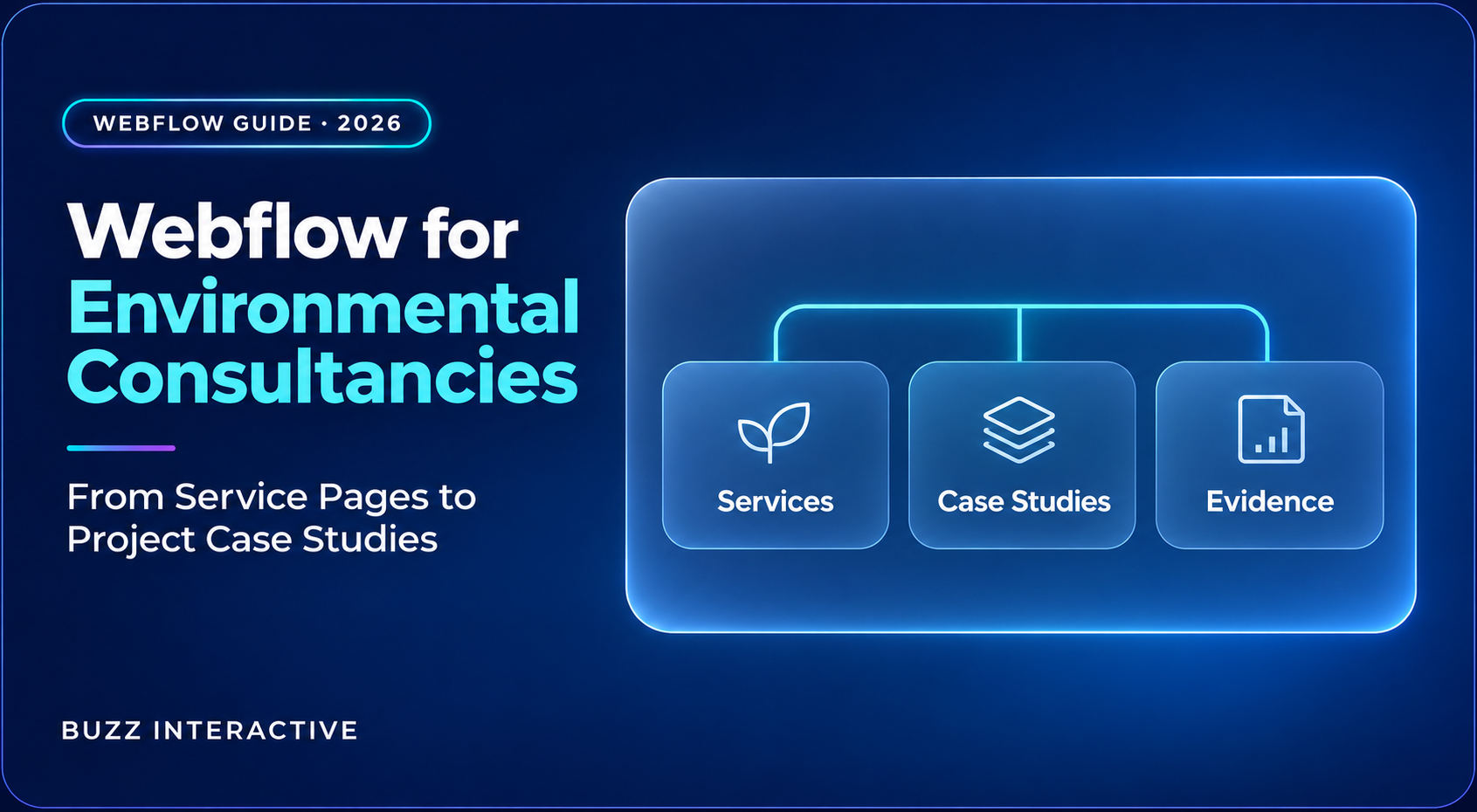
Webflow is a strong fit for environmental consultancies when the website must explain specialist services, publish technical insight and connect every claim to project evidence. Its CMS can link sectors, services, locations, experts and case studies without duplicating page structures. The platform does not create credibility by itself: environmental claims still need a documented basis, appropriate qualification, review ownership and visible methodology.
Buyers rarely shortlist an environmental consultancy because it says it is committed to sustainability. They need to know whether the team has solved a comparable problem, in a relevant sector and regulatory setting, at the required scale. Generic service descriptions and nature imagery do not answer that procurement question.
The common website failure is a gap between capability and proof. Service pages describe carbon accounting, impact assessment, permitting, ecology or renewable-energy strategy, while project evidence sits in PDFs, tender documents or individual staff memories. The buyer cannot connect the promise to a credible outcome.
| Buyer question | Website evidence | Conversion risk if missing |
|---|---|---|
| Do you understand our problem? | Sector, asset type, geography, project stage and constraints | The service feels generic |
| Have you done comparable work? | Relevant case study with scope and role | The firm looks unproven |
| Can we trust the result? | Method, data boundaries, standards and review process | Claims feel promotional |
| Can your team deliver? | Named expertise, responsibilities, partners and capacity | The buyer cannot assess fit |
| What happens next? | Clear consultation route and qualification fields | Interest becomes an unstructured contact message |
The environmental consultancy proof path
Move from a broad capability claim to evidence a technical buyer can evaluate
Service
Project
Decision
Every important claim should lead to evidence, context and a relevant next step.
A service page should define the problem, who the service is for, the stage at which the consultancy becomes involved, inputs required, method, deliverables, decision value and related project evidence. Avoid merging distinct services into a single list when they have different buyers, risks and outcomes.
| Service-page element | What to explain | Why it converts |
|---|---|---|
| Problem and trigger | The event that makes the work necessary | Matches the buyer's current situation |
| Scope | Included work, exclusions and dependencies | Reduces ambiguity |
| Method | Assessment, modelling, fieldwork or reporting approach | Builds technical confidence |
| Deliverables | What the client receives and can decide | Makes value concrete |
| Standards and context | Applicable frameworks, jurisdictions and assumptions | Shows relevance without overclaiming |
| Related projects | Comparable evidence filtered by sector or service | Moves the buyer from promise to proof |
A case study is not a gallery item. It should show the starting condition, client objective, project constraints, consultancy role, work performed, evidence produced, decision enabled and outcome. Where results cannot be disclosed, explain the method, scale and type of decision without inventing precision.
The Enverton and Verdex template structures both emphasize CMS-driven services and projects. That is useful, but the real advantage comes from relationships: one project can support several services, sectors and expert profiles, while each service page automatically surfaces the most relevant evidence.
A CMS model for services and evidence
Structure reusable content so every service can surface relevant proof
Services
Projects
Experts
Insights
Relationships create topical authority without copying the same claims across pages.
Avoid unsupported phrases such as green, carbon neutral, sustainable or environmentally friendly when the page does not define the basis. State the boundary, period, methodology, assumptions, comparison and verification status where relevant. Keep a claim register with a source, owner and review date.
This is both a credibility and compliance issue. Guidance such as the UK Competition and Markets Authority Green Claims Code and the US Federal Trade Commission Green Guides stresses that environmental claims should be truthful, clear and substantiated. Requirements vary by jurisdiction, so legal and technical owners should review material claims before publication.
Renewable-energy audiences may include landowners, enterprise buyers, investors, communities, regulators and talent. Give each audience a clear route. Project portfolios should state technology, geography, development stage and the company's actual role. Dashboards, calculators and production data may require external data sources and custom development rather than CMS fields alone.
| Choose | When it fits |
|---|---|
| Webflow | Brand, services, project evidence and insights are central and the marketing team needs publishing control |
| Traditional enterprise CMS | Large organisations need deep multisite governance, existing integrations and distributed publishing |
| Headless CMS | The same project and technical content must feed websites, portals, apps and partner channels |
| Custom application | Authenticated project tools, live monitoring or complex data products are the core experience |
Buzz Interactive designs and develops Webflow systems that help environmental consultancies explain complex services, publish credible project evidence and guide serious buyers toward the right conversation.
Explore our Webflow design and development services or review our Webflow guide for marketing teams.


