

We develop websites designed to convert.
Built for companies ready to scale
The best web design software is not simply the tool that makes a page easiest to design. It is the platform that helps your organization move from brief to design, build, approval, publication, measurement, and iteration with the least unnecessary friction.
For many B2B teams, Webflow offers the strongest balance of marketing autonomy and design control. WordPress is the more flexible open-source choice. HubSpot Content Hub fits teams that want the website close to their CRM and campaign operations. Framer favors fast, design-led launches. Contentful suits composable, engineering-led architectures. The right answer depends on your operating model.
Assess every shortlisted platform against the same decision criteria:
These are conditional recommendations, not a universal ranking. A tool can be excellent for a five-person SaaS marketing team and a poor fit for a global site with hundreds of editors, regulated approval workflows, and product-data dependencies.
Most web design software lists compare templates, AI features, drag-and-drop editors, price, and ease of use. Those factors matter, but they do not explain how the website will operate inside a company.
The real workflow is longer:
Idea -> brief -> copy -> design -> build -> review -> approval -> publish -> measure -> iterate
Every wait state between those steps creates organizational latency. A landing page that takes two hours to build may still take four days to launch if it waits for engineering, QA, legal, and deployment. Another platform may take five hours to assemble but let the marketing team review, publish, and measure it on the same day.
That is why choosing website design software is an operating-model decision. You are deciding who owns the website, which changes require developers, how brand rules are protected, how experiments are launched, and how much technical debt the team is willing to carry.
A CMO needs a platform that improves marketing throughput, protects the company from operational risk, and produces evidence the buying committee can defend. Ease of use matters only when it improves the complete path from an approved idea to a measurable result.
The answer depends on which tasks become self-service and which guardrails remain in place. Marketing should usually be able to create approved pages, update content and metadata, connect standard forms, publish within policy, and iterate on campaigns. Design and engineering should retain control over the component system, complex code, security-sensitive integrations, performance standards, and architectural changes.
Ask the shortlisted vendor to demonstrate this division of responsibility in the proposed plan. A general claim about ease of use is not enough. The demonstration should show permissions, review, approval, publishing, rollback, and the audit trail around a representative campaign page.
Sales and marketing value comes from faster learning, not simply faster publishing. A platform should help the team create an ICP-specific page, route the right form submission, preserve attribution, measure conversion, launch a controlled variant, and apply the result to the next iteration. If the page launches quickly but the CRM, consent, analytics, or experiment workflow breaks, the organization has not shortened Idea-to-Impact Time.
The recommendation should identify at least five residual risks: vendor lock-in, specialist dependency, governance gaps, integration ownership, and three-year operating cost. It should also explain what happens if the website champion leaves, the site grows to hundreds of pages, a global claim changes, an integration fails, or the company needs to migrate.
The CMO should receive a two- or three-platform shortlist, agreed scoring weights, pass-or-fail requirements, a common workflow test, evidence-confidence grades, a three-year cost model, rejected alternatives, and the conditions under which the recommendation would change. This turns the platform choice from preference into an auditable business decision.
The developer should not ask only whether a feature exists. The better question is whether the feature can be operated, monitored, changed, and transferred by the team that will own it.
Design flexibility is valuable only when it produces a system that remains consistent after launch. The recommendation should therefore distinguish creative freedom for system designers from safe flexibility for daily editors.
Sales should influence the primary workflows and measurement requirements. It should not select the platform based on a demo, a template library, or a preference for one CRM screen.
The content system should reduce repeated writing and editing work while protecting accuracy. Reusable content creates value when it shortens updates, prevents conflicting claims, and makes review easier.
An experiment is not complete when a variant is published. It is complete when the team can trust the measurement, interpret the result, and apply the learning.
QA should validate the exact release path, not a vendor-controlled demo. Test responsive behavior, supported browsers, keyboard access, screen-reader structure, forms, validation, error handling, analytics, consent, redirects, metadata, schema, performance, rollback, and permissions. Record the expected result, actual result, dependency, workaround, and business impact for every failure.
Idea-to-Impact Time is the period between approval of a marketing idea and the first point at which the team can measure its results. It captures the complete execution path, not just design or development time.
An illustrative comparison makes the difference clear:
This is an example, not a benchmark. Your actual time will depend on team skills, page complexity, integrations, legal review, and governance rules. Measure the same workflow in each shortlisted platform before buying.
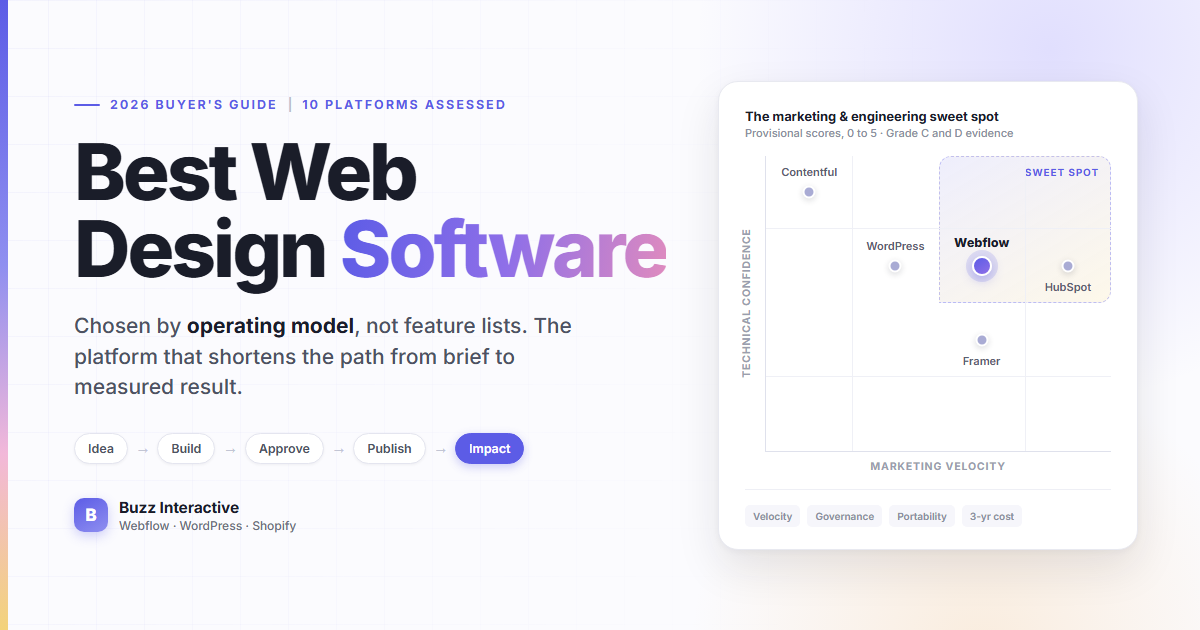
The Idea-to-Impact Framework evaluates the system around the software. It uses two primary dimensions and three supporting checks.
Marketing Velocity measures how quickly an experienced team can repeatedly create, launch, change, test, measure, and improve web experiences.
Evaluate:
Do not confuse fast to learn with fast to operate. A simple builder may deliver a quick first page but become slow when the site reaches 500 pages. A more technical platform may take longer to learn but support faster repeatable work after the system is established.
Use a fixed set of representative tasks and score the complete workflow, including wait states. The score should combine page creation, routine change, experiment launch, global update, and measurement readiness.
Do not convert a vendor demo into a score of 5. Record both active work time and elapsed time. A page that requires one hour of editing and three days of waiting has a three-day organizational cycle time.
Technical Confidence measures whether design and engineering can support the site without accepting unacceptable risk.
Validate:
Marketing autonomy is not automatically good. If speed creates broken design patterns, uncontrolled scripts, weak permissions, or a site nobody can maintain, the organization has only moved the bottleneck into the future.
Score the architecture that will actually be implemented, not the theoretical maximum of the product. Review the proposed hosting, frontend, CMS model, integrations, permissions, release process, monitoring, maintenance owner, and exit path.
Technical Confidence is not a score for how much code a platform permits. It measures whether the team can support the chosen implementation safely over time.
Marketing Independence is the percentage of routine work marketing can complete without engineering help. Score common tasks such as page creation, copy changes, metadata, forms, redirects, analytics, publishing, experiments, and personalization.
A higher score is useful only when the platform also provides appropriate guardrails. The goal is the right dependency, not zero dependency.
Organizational Resilience asks a blunt question: if the person who built the website leaves tomorrow, can another qualified person take over?
Check documentation, component naming, CMS models, permissions, integration records, deployment steps, custom-code ownership, and onboarding time. A site that depends on one expert is an operational risk regardless of the software used.
The true cost is larger than the subscription:
Software + hosting + add-ons + implementation + developer time + design time + content operations + agency support + migration + training + maintenance + delay
A lower monthly fee can produce a higher total cost if marketers need a developer for every campaign change. An expensive platform can also be wasteful if the team never uses its governance, localization, experimentation, or integration capabilities.
Do not place a platform in one quadrant based on its product category. The same WordPress installation can be a sweet spot or a maintenance burden. The same Webflow site can empower marketing or lock routine changes behind one designer. Architecture, implementation quality, plan level, permissions, and team skills change the result.
Run the same scenario, content, tester profile, plan level, integrations, and success criteria for every candidate. Record active time, elapsed time, people involved, approvals, failures, workarounds, and the evidence needed to verify completion.
The common test protocol is complete, but logged-in timings are not. Account access, plan entitlements, sample content, integrations, tester skill, and governance settings materially change the result. The research appendix provides identical start and stop conditions, a time-to-change worksheet, and a friction log so Grade A evidence can be collected without changing the methodology.
This guide's product evidence was checked on August 13, 2026, and expanded on August 18, 2026. Research included the 13 supplied competing URLs, current first-party documentation, G2 review patterns, and recent practitioner discussions. Official documentation supports capability claims. Independent and practitioner sources identify recurring trade-offs and validation questions rather than universal conclusions.
Evidence boundary: Public-evidence platform sheets and provisional 0-to-5 scores are now included. They carry Grade C or D confidence because logged-in, account-level workflow benchmarks were not conducted across all ten platforms. No unmeasured task time is presented as an original result. Before purchase, replace provisional scores with Grade A evidence from the five workflow tests under the proposed plan, integrations, roles, content, and governance controls.
Source order: First-party documentation comes first for factual capabilities. Independent reviews are used for repeated experience patterns. Practitioner discussions are used for edge cases and operational questions. Customer case studies are treated as customer-reported outcomes, not independent proof.
The market gap is clear. Several leading comparison pages still emphasize ease of use, visual editors, templates, AI, pricing, and generic best-for labels. Even more structured evaluations tend to score product capabilities rather than the full organizational path from campaign request to measured result. This guide evaluates both the product and the way the team will work around it.
Webflow separates page building from design-system control. Designers can create approved components and templates, while marketers use the documented page-building workflow o launch pages without editing underlying classes.
Advanced site roles and permissions can separate design, content, review, and publishing responsibilities. The main trade-off is portability: Webflow explains that exported code excludes several hosted capabilities, so migration should be planned as a rebuild rather than a one-click transfer.
Choose Webflow when frequent launches and design quality both matter.
Test carefully when the site requires complex server-side logic, unusual data relationships, or mandatory self-hosting. Buzz Interactive provides Webflow design and development for this hybrid operating model.
WordPress is not one operating model. A controlled custom block system can give marketers safe page building, while an unmanaged collection of plugins and unrestricted admin access can create fragile dependencies.
WordPress documents six default roles and capabilities, a broad REST API, and native content export. These capabilities support portability and customization, but marketing speed still depends on the quality of the theme, blocks, plugin policy, hosting, and maintenance process.
Choose WordPress when open-source control, custom integrations, or publishing depth outweigh the appeal of one managed vendor.
Test carefully when nobody clearly owns updates, backups, plugin review, security, and performance. Buzz offers custom WordPress development built around modular systems and maintainable governance.
HubSpot can remove integration steps when the CMS, forms, CRM, automation, and reporting already share the same operational system. HubSpot documents A/B testing for pages (), including performance comparison and winner selection.
Permissions separate view, edit, and publish access. Content approvals are available under specified Enterprise subscriptions. Developers can package modules, templates, CSS, JavaScript, and fields into reusable HubSpot themes.
Choose HubSpot when reducing friction between the website and HubSpot-powered demand generation creates measurable operational value.
Test carefully when the team needs broad hosting control, a highly custom frontend, or a lower-cost exit path.
Framer compresses design and publishing into one environment. Its roles and permissions can separate Design, Content, and Deploy access on qualifying plans.
On-page editing allows collaborators to update text, images, component properties, CMS content, and SEO fields without full design access. Staging and version controls support review, deployment, and rollback.
Choose Framer when the website is design-led, campaign-heavy, and operationally straightforward.
Test carefully when the site needs complex content relationships, mature enterprise workflows, or application-like backend logic.
Contentful is a headless content platform rather than an all-in-one visual builder. Marketing can manage structured content, but designers and engineers normally own the frontend experience.
Environments isolate content and model changes across development, QA, and production. Granular environment permissions can control editor access. Content and models are also exportable through the CLI, although workflows, apps, history, and credentials may require separate migration work.
Choose Contentful when multi-channel content, composable architecture, and engineering control are core requirements.
Test carefully when a small marketing team must independently design and publish new layouts.
Wix Studio supports workspace and site-level roles, external collaborators, and real-time editing. Its team management documentation explains scoped access, while custom CMS permissions separate content and collection responsibilities.
The managed infrastructure reduces hosting and update work. The strategic trade-off is portability: Wix states that a Wix site must run on Wix infrastructure.
Choose Wix Studio when the organization values an all-in-one managed platform and accepts proprietary hosting. Test carefully when self-hosting, source portability, or a future move to another frontend stack is likely.
Duda is designed around scaled site production. Site comments place internal and client review directly on the site, reducing scattered approval conversations.
Duda supports predefined and custom permission groups. Its team member documentation notes that team members can access all sites in an account, while single-site access is generally managed through client roles.
Choose Duda when multi-site production, client review, and standardized delivery are central.
carefully when the organization needs deep per-site team isolation, bespoke backend logic, or an easy path to self-hosting.
Shopify should lead the shortlist when commerce defines the website. Online Store 2.0 uses JSON templates, sections, dynamic sources, and app blocks. Shopify explains that sections on most pages let merchants arrange layouts while developers maintain modular themes.
Store permissions can separate theme code from blog, page, product, and merchandising responsibilities.
Choose Shopify when product, order, checkout, and merchandising operations drive the experience.
Test carefully when the website is primarily a complex B2B content and demand-generation platform. Buzz provides Shopify development for custom storefronts, integrations, and conversion work.
Squarespace combines managed hosting, templates, and built-in content tools. Its constraints can protect consistency when the site is simple and the team wants minimal technical ownership.
A website editor can change existing content but cannot add pages or change site-wide styles. Standard contributor roles also lack per-page editing permissions.
Choose Squarespace when the site is straightforward and low operational overhead matters most.
Test carefully when the team needs complex structured content, advanced experimentation, granular permissions, or application-like behavior.
Figma Sites extends Figma from interface design into publishing. Its current documentation covers domains, analytics, code layers, accessibility settings, and CMS content. The Figma Sites CMS supports collections, lists, and dynamic pages.
Organization administrators can manage external publishing and password requirements through documented web-publishing controls.
Choose Figma Sites when the team wants to test a design-to-publish workflow on a site with manageable technical requirements.
Test carefully when the website is mission-critical, content-heavy, or dependent on mature integrations and governance.
A platform should not be selected on the quality of the launch demo. Evaluate what the website will be like to operate two years later.
Ask:
The platform matters, but implementation discipline matters just as much. Naming conventions, reusable components, content models, documentation, permission design, analytics standards, and a clear change process determine whether the site remains an asset.
A platform is operationally resilient when another qualified person can understand, access, maintain, and safely change the website without relying on undocumented knowledge held by one individual. Treat this as a required takeover test, not a theoretical concern.
Ask the current website owner to prepare a handover package and then have a second person complete a representative change using only that package.
If the takeover test fails, reduce the Organizational Resilience score even when the platform itself is well documented. The implementation and operating model create the dependency.
Build a three-year total cost model. Include:
Do not overlook traffic and asset limits. The supplied Webflow plan example shows that bandwidth varies by plan, while the supplied overage example illustrates how high-request image assets can trigger additional usage and a plan change. Treat these screenshots as examples, then confirm current limits, surge protection, overage rules, and upgrade behavior on the exact plan before purchase.
Use an illustrative delay calculation rather than an invented savings claim. If a campaign is expected to generate 40 qualified opportunities per month and a platform-related bottleneck delays launch by three weeks, the business should model the opportunity cost of those lost learning and pipeline days. The estimate should use the company's own conversion and revenue data.
The quiz identifies your likely website operating model before it recommends a shortlist. Answer each question in order. For every answer, ask the vendor the matching questions, collect the requested proof, and remove any candidate that fails a non-negotiable requirement.
A standalone implementation is included with the editorial deliverables.
Questions to ask: Can you demonstrate our primary workflow from creation through measurement? Which required capabilities depend on another product, add-on, plan, or custom build?
Evidence to collect: A recorded demonstration using the proposed plan, real integrations, sample content, and the roles the company will use.
Red flag: The vendor demonstrates page styling but skips the business transaction, form routing, analytics, approval, or post-launch workflow.
Questions to ask: Which exact tasks can each role create, edit, review, approve, publish, and roll back? Can permission boundaries be demonstrated instead of described?
Evidence to collect: A role-and-task matrix plus a live test in which marketing publishes an approved page while protected design and technical controls remain inaccessible.
Red flag: Autonomy depends on giving every contributor unrestricted production access.
Questions to ask: How long does the complete campaign workflow take for an experienced operator? Which steps enter design, engineering, legal, analytics, or vendor queues?
Evidence to collect: Timed tests for a new page, routine update, variant, metadata change, form, analytics verification, and rollback.
Red flag: The claimed publishing speed measures editor clicks but excludes approvals, QA, integrations, and measurement.
Questions to ask: Who can create or change components, variants, styles, tokens, breakpoints, motion, and accessibility behavior? How are exceptions reviewed?
Evidence to collect: A component-system demonstration that includes a new approved pattern, marketer assembly, global update, responsive QA, and protected design rules.
Red flag: Either marketers cannot assemble routine pages or every editor can change the underlying design system.
Questions to ask: What can developers customize, where does custom code run, how is it versioned, and who monitors integrations? What limits, rate rules, and recovery processes apply?
Evidence to collect: One real API or webhook, environment and rollback proof, deployment ownership, monitoring responsibilities, and an architecture diagram.
Red flag: A critical requirement depends on unsupported code, an unowned integration, or a service that cannot be tested outside production.
Questions to ask: Can access follow least privilege? Which controls require higher plans? What evidence supports security, privacy, incident response, and data residency requirements?
Evidence to collect: A permission demonstration, current security documentation, contract commitments, audit evidence, and a review by the buyer's security owner.
Red flag: Governance exists in marketing material but not at the content, site, locale, environment, or publishing scope the company needs.
Questions to ask: What content, assets, code, users, forms, search, localization, history, redirects, analytics, and workflows can be exported? What must be rebuilt?
Evidence to collect: A representative export, migration map, skills assessment, documentation sample, contract exit terms, and ownership-transfer rehearsal.
Red flag: The team discovers export or ownership limits only after implementation.
Use the quiz to create a two- or three-platform shortlist. Then complete the worksheet and scoring method using evidence from the same workflow tests for every candidate.
Use one copy of this worksheet for each shortlisted platform.
Score only after the buying team agrees on requirements, weights, evidence standards, and common workflow tests. A transparent score supports a decision; an undocumented score only makes opinion look precise.
Remove a platform before scoring if it fails a non-negotiable requirement such as:
Use a total weight of 100%. The example below is a starting point, not a universal model.
Adjust the weights before evaluating platforms. A regulated enterprise should increase governance and security. A product-integrated website should increase technical confidence and integration. A campaign-heavy team should increase marketing velocity and experimentation.
Weighted platform score = sum of each criterion score multiplied by its agreed weight.
Example: a score of 4 for a criterion weighted at 20% contributes 0.8 points to a five-point total. Keep the unrounded result, the underlying evidence, and the reason for every score.
Do not let a high platform score hide weak evidence. A 4.4 score built mostly from Grade C or D evidence should not outrank a 4.1 score validated through the team's real workflow without an explicit risk discussion.
The final recommendation should fit on one decision page before the supporting research. Use the same pattern for every buying committee:
This format helps sales, marketing, design, engineering, finance, security, and leadership debate the same evidence instead of defending different product preferences.
Choosing web design software is not really a choice between feature lists. It is a choice about how marketing, design, and engineering will work together.
The CMO needs to know: Can the team move faster, learn sooner, and control the operating risk?
The designer needs to know: Can the system produce and protect the experience the brand requires?
The engineer needs to know: Can the site integrate, perform, scale, and change without creating unnecessary technical debt?
The best platform is the one that gives all three teams a workable answer. If your buying committee needs a defensible shortlist, bring Buzz Interactive the operating model, current workflow, required integrations, and risk constraints. The team can help evaluate the shortlist and implement the selected platform through website services


.svg "Upward index finger gesture icon")


